Type reference · side-mount ball-bearing
Side-mount drawer slides: recognize them before replacing them
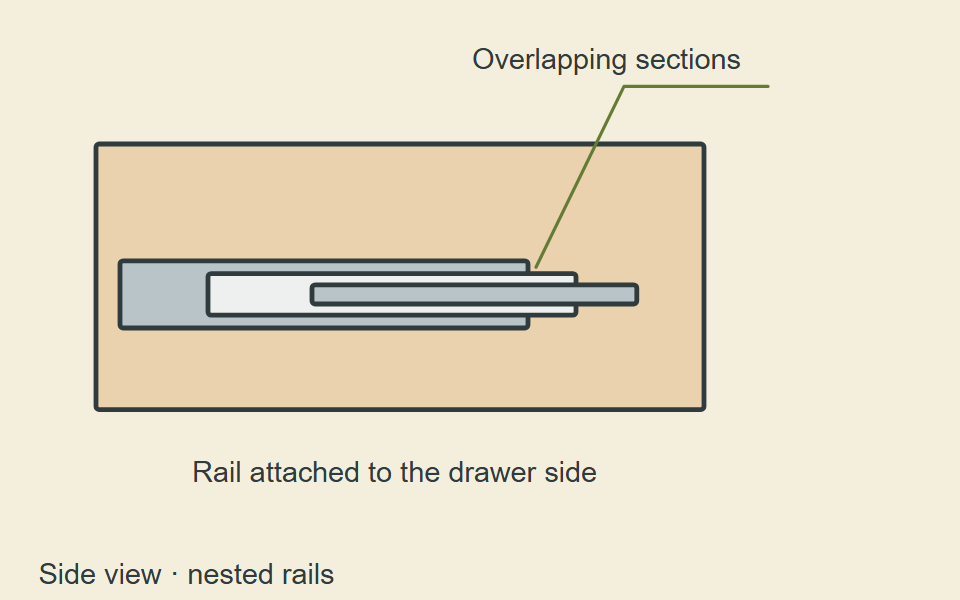
Look for overlapping metal rails attached to both sides of a separate drawer box. Knowing this family gives you a starting point; it does not establish the size, closing function or fit of a replacement.
Does this match your drawer?
The sections slide inside one another rather than running on a large exposed plastic wheel. A release lever may be visible when the drawer is extended, but release methods differ.
I have side-mount ball-bearing slidesNext, choose what you want to do: fix, replace or improve the drawer.
What this design tells you — and what it doesn’t
Side-mounted rails are used on cabinet drawers, furniture drawers and pull-outs where the drawer sides provide mounting surfaces. The rails occupy space between the box and its surroundings. That space, the supporting cabinet structure and the drawer’s dimensions matter more than whether two slides look similar in a photo.
- The mounting family
- You can see rails on the sides and compare how they attach to the box and cabinet. Do not use the decorative drawer front as a substitute for measuring the box.
- The travel
- Some models stop short of full access; others extend farther. If greater access is your aim, use the full-extension upgrade route before choosing a new model.
- The closing action
- Ball bearings do not automatically mean soft-close. Record what your current drawer does so a replacement does not unexpectedly remove a feature you use.
- The capacity
- A load rating belongs to a tested product and mounting arrangement. It is not a rating for all ball-bearing slides, and it is not a guarantee for a damaged drawer box. See how drawer-slide capacity is assessed.
Replacing one damaged side is not always a one-part job
First distinguish a loose screw or bracket from a bent main rail or failed bearing assembly. A small replaceable part can have a different remedy from a damaged slide.
When a main rail in a paired installation has failed, plan around a matching replacement pair unless the manufacturer confirms a compatible service part. Do not combine an inner rail from one model with an outer rail from another because they happen to slide together. Likewise, a new left slide and an unrelated right slide are not a verified working set.
Keep any model markings, handed parts and mounting brackets until you have identified the replacement. The Planner separates component replacement from replacing the complete slide system.
Before ordering a same-type replacement
- Record the closed rail length. Measure the hardware, not the drawer front. Keep a printed model number separate from a length marking. The measurement guide explains what to record.
- Check the available mounting space. Compare the drawer-box width with the opening where the slides actually mount. Use the candidate’s specified side space; a commonly quoted half-inch is not a universal fit rule. See drawer-slide clearance.
- Check the attachments and cabinet support. Hole positions, mounting surfaces and rear brackets can differ. Do not assume that using the old holes will position a new rail correctly.
- Match the behavior you want to keep. Check travel and any self-closing, soft-closing or push-to-open function in the candidate’s documentation. Then follow the side-mount installation guide for execution.
Considering hidden runners instead?
Changing to concealed undermount can involve the drawer box, its bottom and rear attachments as well as the runners. Use the side-mount versus undermount comparison to decide whether that change serves your goal. If you already want to make the switch, assess conversion feasibility before buying hardware.