Compare · add a device or change the runners
Soft-close adapters vs soft-close drawer slides
A soft-close adapter adds a separate closing device while keeping the running hardware. Replacement soft-close slides change that hardware. If a documented add-on fits, works with your existing functions and solves the task, replacing the slides is not automatically the better choice.
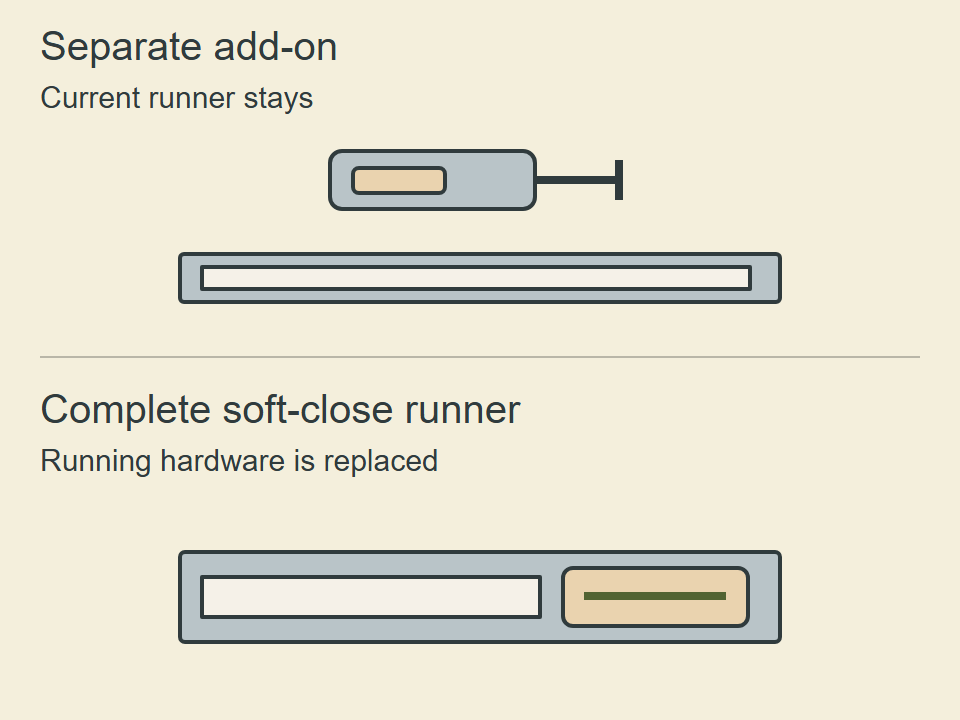
What each option can change
- Separate add-on: keep the runners
- A suitable device adds the closing function without replacing the supporting slide system. That can keep the work small when the current runners are sound and the exact add-on is documented for the setup. It does not repair damaged runners or, by itself, increase their travel or load rating.
- Replacement slides: change the running hardware
- The closing mechanism is part of the selected runner system. This route may address worn hardware or combine soft-close with another documented change. It also requires checking the replacement’s fit, mounting and functions as a complete system; matching nominal length is not enough.
Compare the total job, not only the price of a damper or a pair of slides. Include required catches, brackets or other fittings, access for installation, changes to the box and any mounting-point repairs. The smaller part is not always the simpler installation.
Which checks decide between them?
- Is the current running hardware usable? An add-on makes sense only alongside hardware that supports and moves the drawer correctly. Separate a closing-function upgrade from an unresolved structural or running problem.
- Is compatibility documented? For an add-on, verify the supported drawer/hardware arrangement, attachment and operating space. For replacement slides, verify the selected model’s mounting family, length, clearances and required drawer preparation. A listing that says “soft-close” is not a fit specification.
- Does the complete setup retain what you need? Check existing extension, opening method and other closing functions. Keeping the old rails does not prove an added device cannot interfere with travel or push-to-open. Replacing the rails does not guarantee equivalent travel or functions either.
- How much work is actually required? If both routes meet the task, a verified add-on may avoid unnecessary replacement. If none fits, investigate a matched replacement. When the evidence is incomplete, identify or measure first rather than treating uncertainty as a reason to convert the drawer.
Compare the routes for your drawer
Start with whether you have found an add-on. The Planner keeps “found,” “compatible” and “not verified” separate, then asks only the checks needed for the next route.
The interactive Planner needs JavaScript. The guidance on this page remains available below.
Gather the missing evidence before buying
If the hardware is unfamiliar, use the old-slide identification guide to record construction, markings and attachments. For size checks, use the measurement guide, then the exact candidate’s drawing. Do not transfer a clearance, mounting position or trigger travel from another product.
For the full sequence across wood boxes, concealed runners and metal-sided systems, continue with the soft-close upgrade guide. If the drawer already had working soft-close and it failed, use the repair checks before choosing another device.