Type reference · concealed undermount
Undermount drawer slides: identify the runner system first
Concealed undermount runners sit beneath a separate drawer box, usually as a left-and-right pair. Their hidden position is easy to recognize; a compatible replacement depends on the actual system and the drawer built around it.
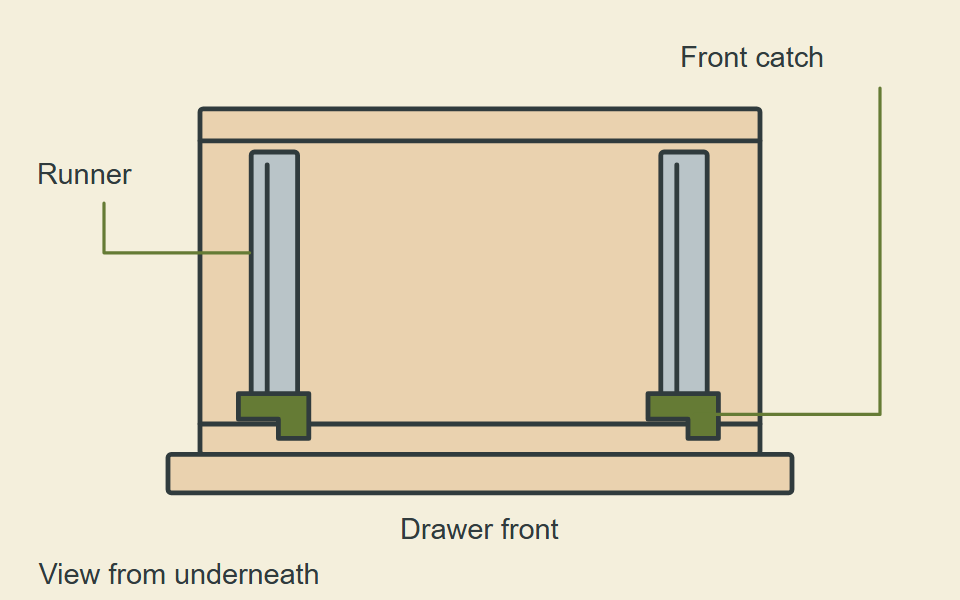
I have concealed undermount runners
This confirms the family only. The Planner will ask your goal next.
Look underneath, then look for a name
An open drawer may show almost no hardware from the side. Inspect beneath the front corners for catches or locking devices, and look along the runners for a manufacturer logo or part marking. Record both a runner marking and a locking-device marking if you can read them; they need not be the same number.
For example, Blum’s identification guide shows logos on runners and locking devices. It also explains that some TANDEM variants use a hook-and-peg attachment rather than a front locking device. Treat the clips as a clue, not a universal requirement or a reliable way to guess a brand.
If you cannot see enough to identify the system, use the old and unknown hardware identification route. A useful record says what the part is, where it attaches and which markings are readable; a guessed product name is less useful.
The box and runners have to work together
These runners suit applications where visible side rails would be undesirable, including kitchen cabinets and furniture. Their concealed position does not make all models interchangeable. A runner can be the right nominal length and still be wrong for the drawer’s construction.
- Drawer width and sides
- The target system specifies the relationship between the opening, drawer width and side construction. Use its drawing rather than transferring a dimension from another undermount system.
- Bottom and rear preparation
- The drawer bottom’s position, rear notches or holes, and the runner’s rear engagement must suit the selected system. Compare the actual box with the relevant installation drawing before modifying it.
- Front attachment
- A catch or locking device must be compatible with the runner and its drawer application. Similar color or appearance is not evidence of interchangeability.
- Cabinet mounting
- The mounting surface and any rear supports depend on the cabinet and runner. Start with face-frame versus frameless construction if that part is unclear.
The undermount sizing guide brings these fit checks together. For recording a length or other measurement, use how to measure drawer slides.
What actually needs replacing?
A broken front catch, a drawer that has not engaged correctly and a damaged main runner can produce different repair paths. Inspect which part is affected before treating the whole system as failed.
For an identifiable damaged component, look for the documented service part for that system. For a main runner failure, establish the appropriate complete replacement set and its attachment requirements. If the old system cannot be matched, a different concealed runner may require changes to the drawer; it is not automatically a drop-in upgrade.
Once the chosen system and box are compatible, follow its instructions alongside the undermount installation guide. Do not use a generic sketch as a drilling pattern.
Soft-close is a feature to verify separately
Record how the drawer opens and closes now. Runner families may offer different motion options, and a compatible physical fit alone does not prove that a replacement preserves soft-close or push-to-open. Use the documentation for the exact runner, locking devices and any motion components you intend to keep.