Identify · mounting support
Face-frame vs frameless: what changes for drawer slides?
Look at the structure around the drawer opening, not the style of its front. A face frame can put the opening in front of and inside the cabinet sides, changing where a runner needs support.
Match the opening you can see
Open the drawer enough to inspect the surrounding construction. Choose the closest description below; “Not sure” keeps that detail open. The choice records the cabinet context, not a slide type.
The interactive Planner needs JavaScript. The guidance on this page remains available below.
Why the front edge matters
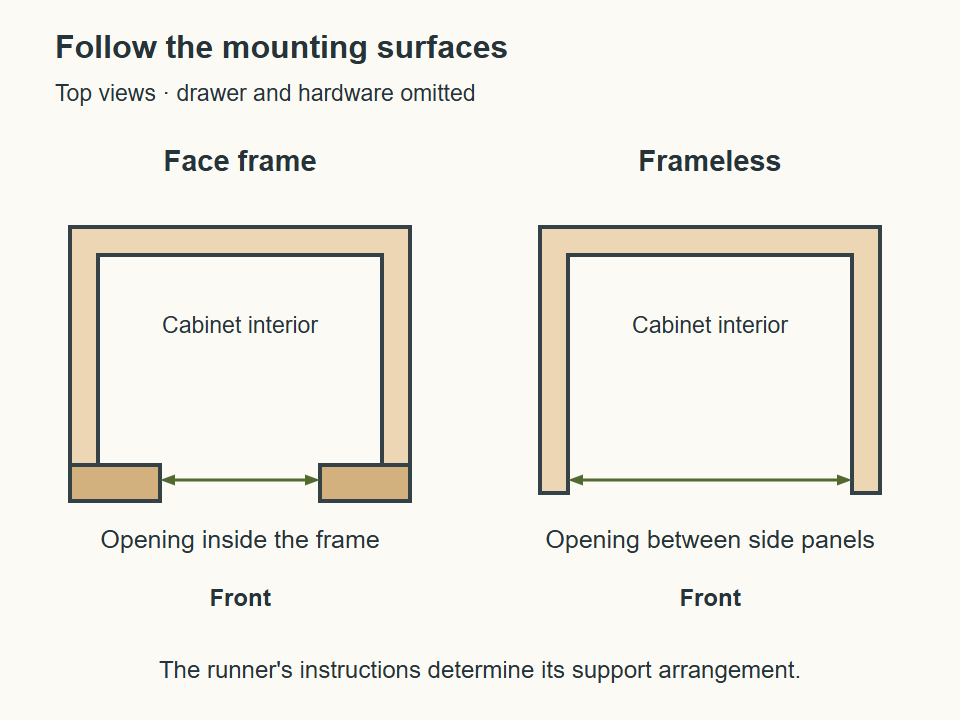
- Face-frame cabinet
- A separate frame surrounds the opening. Look behind it to see how the runner is supported. Depending on the system, mounting may use a specified rear bracket or another documented support arrangement.
- Frameless cabinet
- The cabinet side panels reach the front without a separate surrounding face frame. Check the side-panel fixing positions and material required by the runner’s installation instructions.
- Dresser or other furniture case
- Runners may attach to internal rails, blocks or other case members. Inspect those actual supports. Furniture construction is not automatically equivalent to a kitchen-cabinet mounting layout.
- Not sure
- Keep the context unconfirmed and check it when an attachment or fit decision needs it. You can still identify the running hardware or investigate a separate drawer problem.
Check the support before choosing a bracket
- Follow the runner back. See whether it meets a side panel, block, rail or rear bracket. Check that the existing attachment is secure and undamaged.
- Match the actual hardware. A rear bracket must belong to a compatible mounting arrangement; appearance alone is not proof.
- Check the fixing material. Do not assume a thin back panel is the support required by the selected instructions. Look for the specified structural fixing surface.
- Keep the runner path aligned. A usable front opening does not prove the mounting faces remain parallel or unobstructed farther inside.
A face frame does not mean every slide needs the same rear bracket. A frameless box does not remove the need to check fixings, setbacks or drawer geometry.
Apply the context to your job
For concealed runners, compare the box-sizing requirements before following the installation sequence.
If you are changing from side-mounted slides, use the conversion guide. Cabinet construction is one part of that decision, alongside box geometry, depth and attachment requirements.
The helper’s “Use this context in Planner” button carries your selection into a task on this page. It asks what you want to do next. You can change the observation later; keep your own note before closing or reloading the page.