Fix · a drawer that opens by itself
Drawer won’t stay closed?
Check whether the cabinet tilts and the running hardware is secure before replacing anything. Then identify what normally keeps the drawer shut: self-close, a catch, or a push-to-open mechanism. A drawer rolling open does not by itself establish that its slides need a higher weight rating.
Start with level and mounting
The Planner begins with these visible checks and asks about the closing mechanism only if needed. If you have not checked something, say so rather than guessing.
The interactive Planner needs JavaScript. The guidance on this page remains available below.
Rule out movement caused by the cabinet or its supports
Check the cabinet’s level and stable support. Note whether the drawer tends to roll outward as soon as it is released. Correct a confirmed tilt using the furniture’s intended adjustment and support arrangement, then recheck. Do not compensate for an unstable cabinet by adding a stronger catch.
If level has not been checked, keep that as the next action. A heavier-duty slide rating does not establish that the drawer will stay closed. Use the mounting and adjustment checks for loose supports, fixings and runner alignment.
Check that the runners are secure and correctly aligned
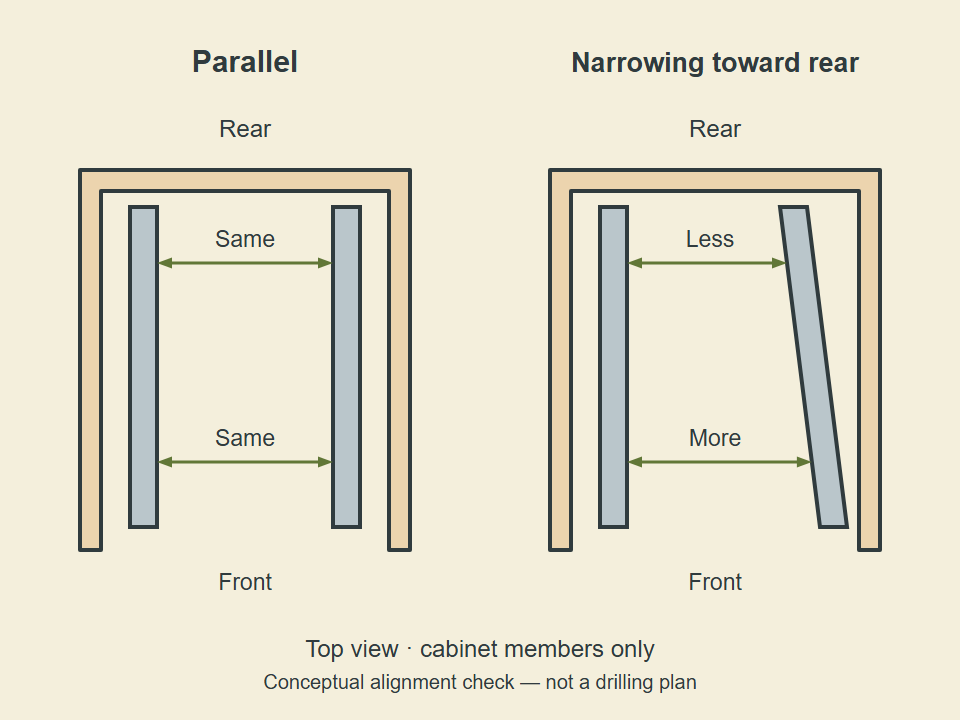
Look for a shifted bracket, loose mounting point or runner that has moved out of position. Fix a sound mounting point according to the hardware’s instructions and retest. If a fixing cannot grip because the supporting material is damaged, repair that support rather than leaving the rail loose.
For paired hardware, compare both sides. A single center track is a different arrangement and needs its centerline and supports checked. Avoid changing the slope of a rail to create a closing force that the manufacturer did not specify.
Identify what should keep the drawer shut
- It normally pulls itself shut near the end
- Check whether an obstruction or engagement problem prevents that final action. The Planner continues into the existing self-close checks and asks whether it works after correction. Self-close and slowed closing are separate observations.
- A push-to-open mechanism holds it closed
- Check the latch path and the exact system’s activation movement. A front that cannot move as required can interfere with operation. Keep the specified working gap; do not add an unrelated catch or force the front flush as a default fix.
- It has a simple catch or hold-in action
- Inspect accessible mounting and alignment first. A separate worn retention part may permit a matched component repair while the main runner stays. If retention is part of a failed main mechanism, identify that hardware before choosing its replacement.
- You do not know what retains it
- Look for visible loose or damaged parts and identify the existing setup. If nothing is clearly wrong, keep the intended retention as an unresolved check. Do not assume every wooden runner, furniture track or proprietary drawer uses the same catch.
Use the opening and closing behavior guide to compare these functions. The Planner retains the “opens by itself” problem while checking the mechanism you identify.
When a repair or replacement is justified
Separate a localized damaged catch or guide from failed running hardware. Verify a repair part’s shape, attachment and retention behavior before ordering. If it is unavailable, or the main mechanism has failed, use the replacement guide for the identified construction.
If the drawer still rolls open after level and secure mounting are confirmed, check an appropriate retention solution for that setup. A proposed same-type replacement must provide suitable hold-in or self-closing behavior as well as fitting physically. For wood or unidentified older hardware, establish the intended retention before choosing a replacement.
Preserve working soft-close or push-to-open functions when changing parts. A higher load rating alone does not describe how a drawer behaves at the closed position.
Recheck after one correction
With the drawer properly seated and required fixings secure, close it normally and check whether it remains closed. Test its normal opening and closing action too. If it never reaches its closed position, use the incomplete-closing checks; stopping short and reopening after closing are different observations.