Convert · check the box before the runners
Can you convert side-mount slides to undermount?
Sometimes, but concealed undermount runners are not a direct substitute for side rails. The existing drawer box, cabinet opening and mounting surfaces must meet the chosen system’s requirements. The practical result may be a compatible conversion, a modified or new box, or a simpler side-mount upgrade.
Check your conversion in stages
Start by confirming the current hardware. The Planner then asks for the drawer width, opening width and side thickness, with measuring diagrams. Enter what you can check; missing measurements give you a useful next step. Cabinet depth and construction come later only when needed.
The interactive Planner needs JavaScript. The guidance on this page remains available below.
Why removing the side rails is not enough
Side-mounted slides use space beside the box. Concealed runners also depend on the box’s underside and attachment details. Removing the side rails does not establish that the remaining box has the right width, bottom recess or preparation for a different system.
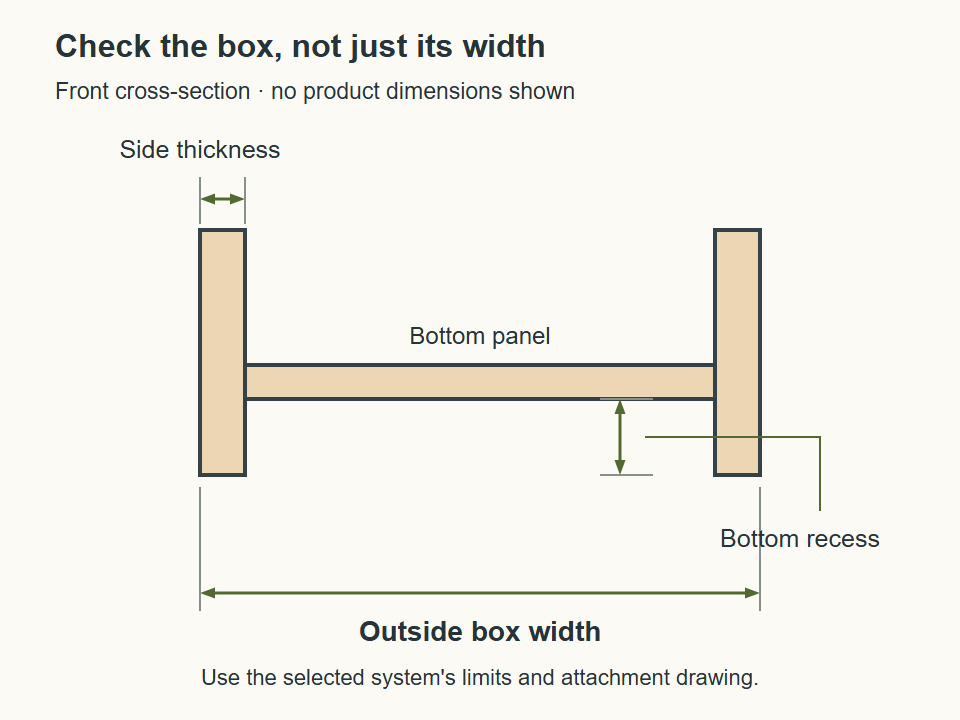
For example, the TANDEM 563H/563. instructions relate box width to side thickness and specify bottom clearance, locking devices and rear preparation. Those requirements belong to that system. Do not turn a width deduction from one drawing into a rule for every undermount runner.
Compare the existing box with one target system
- Identify the starting hardware. This route is for telescoping metal rails mounted along both sides of a separate box. If you have roller channels, a center track or formed metal drawer sides, identify that construction before applying side-mount conversion advice.
- Record the initial geometry. Measure the box’s outside width, the opening at the intended mounting position and the material thickness of a drawer side. Measure the box rather than its decorative front. The total difference between opening and box width is not proof of equal space on each side.
- Check the target drawing. Verify whether it specifies inside or outside width and compare the permitted side thickness. Then use the undermount sizing checklist for the bottom recess, box length and required attachments. A matching width alone is not an approved conversion.
- Check depth and support. Measure usable cabinet depth to the nearest obstruction at the intended runner position. Confirm how the runner will be supported. Face-frame, frameless and furniture-case construction can require different mounting arrangements; a rear bracket is useful only where the chosen system specifies it.
Keep the selected model, version and installation drawing with your measurements. Do not drill, notch or resize the box until the complete arrangement has been checked.
Choose the next step from what fits
- The documented requirements look workable
- Confirm the remaining depth, underside and attachment checks, then follow undermount installation alongside the exact manufacturer’s instructions. A promising initial check is not proof that every preparation detail is correct.
- The box or cabinet would need changes
- List those changes before ordering: box dimensions, bottom construction, attachment preparation or mounting supports. Compare the work with making a suitable new box. Do not describe this as a direct-fit replacement.
- You mainly want better access or a closing feature
- Check whether compatible side-mounted hardware can meet that goal while retaining the current architecture. For access, use the full-extension upgrade guide. For closing, use the soft-close upgrade guide. Concealed hardware can still be your preference, but these functions alone do not require it.
- The target system or a measurement is unknown
- Keep conversion as a possible direction and collect the named missing evidence. Retaining a serviceable current setup is an option while you check. Uncertainty is not proof that the conversion fits or that rebuilding is necessary.