Upgrade · quieter closing
How to upgrade drawers to soft-close
Start by checking for a compatible add-on that keeps your current runners. If that route does not work, look for soft-close hardware of the same type. Changing the drawer’s mounting system is a further option, with more fit checks and possible box modifications.
Find a route for your drawer
The Planner first asks whether you have found a possible add-on. Finding one and verifying that it fits are separate steps. You can answer “not sure”; it will ask about the drawer’s construction when that information is needed.
The interactive Planner needs JavaScript. The guidance on this page remains available below.
Make sure this is an upgrade, not a failed function
If this drawer used to close softly, begin with soft-close troubleshooting. Adding another damper does not establish why the original mechanism stopped working. A drawer that binds, has loose supports or has damaged runners also needs that problem addressed first.
Soft-close controls the last part of closing. It does not by itself provide full extension, a higher load rating or push-to-open. Read the opening and closing comparison if you are unsure which function you want to add.
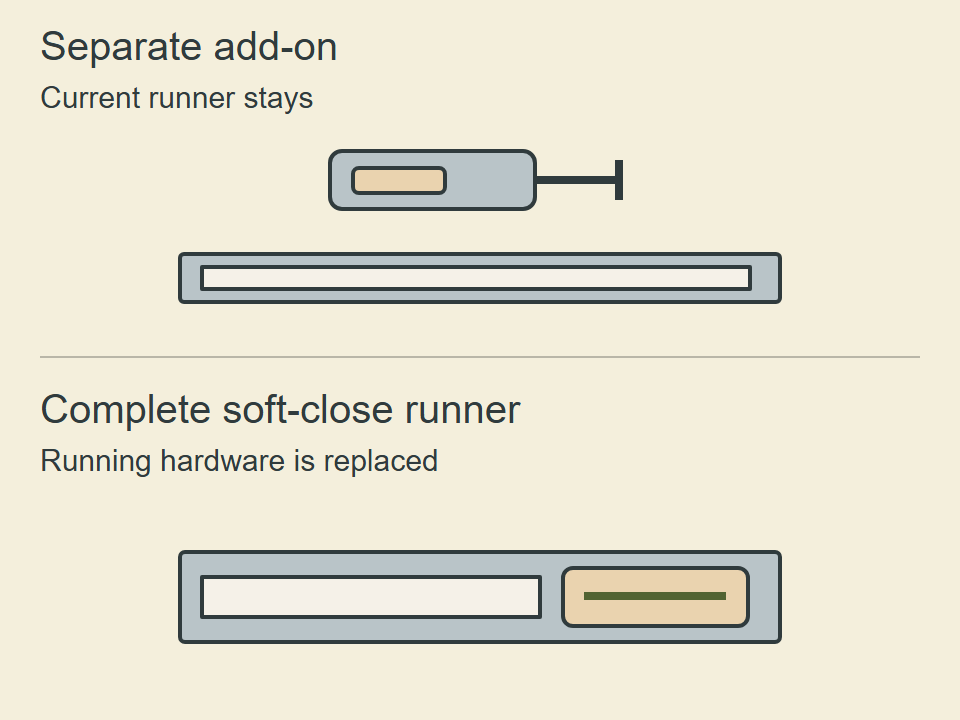
Check the least disruptive compatible option first
- A documented add-on. Check that its instructions cover your drawer and existing hardware, with suitable fixing surfaces and enough working space. The drawer must still reach its intended closed position and travel without interference. A spare patch of cabinet wall alone is not evidence that a device fits.
- Soft-close hardware of the same type. If no suitable add-on is verified, compare a replacement within the existing mounting architecture. Check the exact candidate’s length, clearances, supports, mounting orientation and drawer preparation. “Same type” does not mean the old screw holes or brackets can be reused.
- A conversion. Consider another mounting arrangement when the simpler routes have been checked and do not meet the task. The drawer box may need modification or replacement. A conversion suggestion is a direction to investigate; it does not confirm that the new system will fit.
Use the adapter-versus-slide comparison for the tradeoffs between the first two routes. “Not checked” is still an open check, not proof that an option is unavailable.
Use the hardware you have to narrow the search
- A wood box with separate side or center hardware
- Identify the mounting family before comparing replacement slides. A soft-close side rail is not a direct replacement for a single center slide or a wood-on-wood guide. For older furniture, establish how the drawer is supported before planning new running hardware.
- Concealed runners below a wood box
- Find the exact system and version. Check its documented soft-close options, drawer preparation, locks and rear engagement. A similar-looking runner or a logo by itself does not confirm interchangeability.
- Formed metal drawer sides
- The sides belong to a drawer system. Look for that system’s supported upgrade parts before treating it as an ordinary wood box. Blum’s METABOX range, for example, has a documented BLUMOTION option; that is not evidence that the same device fits another metal drawer.
- The construction is still unclear
- Use the illustrated slide-type guide or the Planner. Keep an uncertain model uncertain until markings, construction and matching documentation agree.
Before ordering, check fit and the functions you want to keep
Use the measurement guide to separate slide length, drawer depth and usable cabinet depth. Then compare your actual dimensions with the selected hardware’s instructions. Add-on operating space and runner installation clearance are different checks; neither has one universal measurement.
Record how far the drawer opens and whether it has push-to-open or another opening/closing feature you use. Confirm that the complete proposed setup retains those functions, or consciously accept a documented change. Do not assume an arbitrary push latch and soft-close device will work together.
Install and test according to the selected system’s instructions. Start with an empty drawer, check engagement and the full opening/closing cycle, then check normal use within the documented rating. Stop if parts collide, the drawer will not latch or the mounting moves; added damping is not a cure for poor fit.