Check fit · concealed runners
Undermount drawer sizing requirements
Choose the exact runner system before deciding whether a drawer box will fit. Width alone is not enough: the sides, recessed bottom, depth and attachment details must work together.
Start with the system you intend to use
For replacement, find the existing runner and attachment markings. For a conversion, find the proposed kit’s drawing. If neither is known yet, the helper gives you a useful starting point without asking for dimensions that may not apply.
The interactive Planner needs JavaScript. The guidance on this page remains available below.
The box has more than one fit constraint
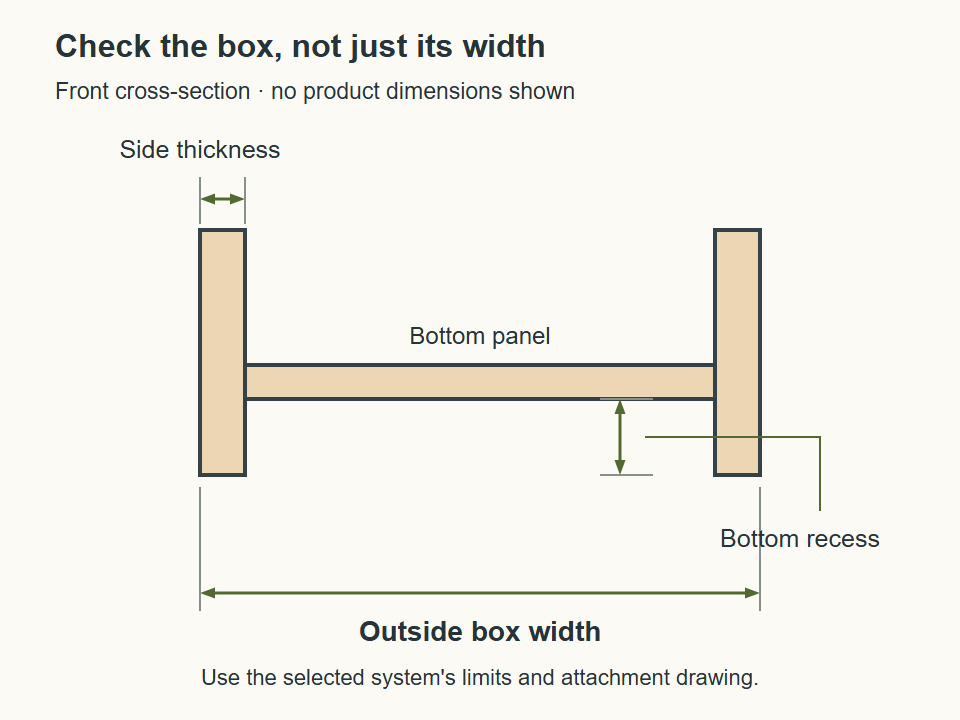
- Opening and box width
- Check whether the drawing specifies inside or outside drawer width. Side thickness affects the relationship between them. Do not reuse a width deduction from a different runner family.
- Drawer-side thickness
- Measure the material itself. Match the permitted range for the chosen version; a product name or nominal length alone does not establish that range.
- Bottom recess and clearance
- Check the space beneath the bottom panel and the runner’s position below the drawer. A box that fits between the cabinet sides may still sit incorrectly on its runners.
- Drawer length and usable cabinet depth
- Compare the specified box length with available depth at the intended mounting position. Include the space needed for rear attachments and any front setback.
- Front and rear attachments
- Use the matching locking devices or other specified fixing arrangement. Check rear hooks, holes or notches only against that system’s preparation drawing.
Before ordering, put these details together
- The exact candidate. Keep its model, length, version and installation sheet together. A similar-looking runner or clip is not a compatibility check.
- The relevant box measurements. Record the values the drawing actually needs, with units and measuring points. Use the measurement guide for physical length and markings.
- The mounting support. Identify the cabinet or furniture construction. Check the intended support behind a face frame and any specified rear brackets.
- The functions to keep. Verify the correct opening/closing mechanism and its required parts. Do not assume a soft-close or push-to-open accessory transfers between systems.
If one requirement is still unknown, keep it as a named check before purchase or modification. Do not drill, notch or resize the box from this conceptual drawing.
Which guide comes next?
The box and selected system match
Follow undermount installation alongside the exact manufacturer’s instructions for preparation, attachment and adjustment.
The drawer currently uses side rails
Use the conversion guide to check whether adapting the box is practical. A conversion can require changes beyond replacing the slides.
Check a side-mount to undermount conversion
This choice starts by checking the current hardware. Reading this page does not assume you have side-mounted slides or want to convert them.