Type reference · channels and wheels
Euro / roller drawer slides: recognize the wheels and channels
Visible plastic wheels running in simple channels are the main clue. These slides usually sit near the lower side edges of a separate drawer box. They are often called epoxy-coated slides, and sometimes “bottom mount.”
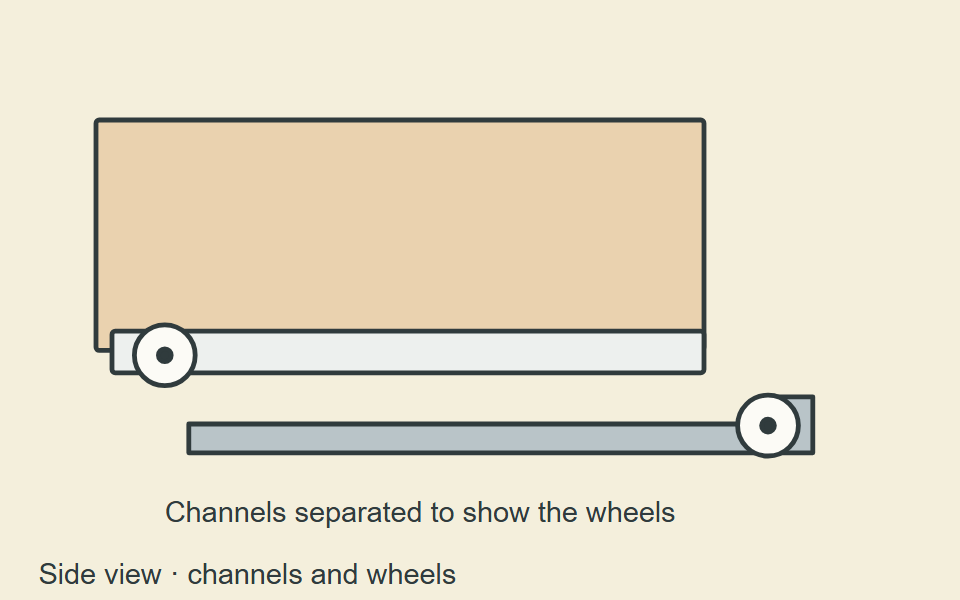
Does your hardware look like this?
Look for an exposed wheel and formed channel, rather than several nested telescoping rails. The paint color is not a reliable model identifier.
Next, choose whether to fix, replace or improve the drawer.
Compare other slide types if the mechanism is different.
“Bottom mount” is not enough information to order
A drawer-side channel can wrap around the lower edge of the box, which explains that label in some listings. It does not make this the same system as concealed undermount runners. Nor does it tell you whether a replacement has the same wheel position, profile or mounting requirements.
Describe what you see as “Euro / roller channels with visible wheels,” then record any markings. That is a better starting point than matching the white or cream finish in a product photo.
What may be normal — and what needs investigation
- Some drawer stays inside
- A partial-extension model does not expose the entire box when fully open. A smooth stop can be normal for that model. A drawer that used to open farther and now catches needs a different explanation.
- It pulls itself closed near the end
- Some roller slides have a self-closing profile. Self-close does not necessarily mean a damped, soft final movement. Confirm the documented function before deciding a missing soft-close action is a fault.
- It lifts out for removal
- Many roller designs use a lift-out arrangement, but the position and sequence are model-dependent. A drawer that meets a stop is not an instruction to pull harder or twist the channels apart.
- A wheel rubs, jumps or binds
- Look for accessible debris, loose mounting, a damaged wheel or a distorted channel. Record the finding for the Planner; the sound alone does not prove that the entire set has failed.
Replacing rollers like for like
A matching roller setup can be the simplest route when the current arrangement suits the drawer. Separate a damaged replaceable component from damage to the main channels. If the complete system needs replacing, establish the matching drawer and cabinet members for both sides; do not mix an old channel with an unrelated new roller just because it appears to engage.
Check the candidate’s length, profile, mounting space and attachment positions. Use how to measure drawer slides to record the hardware and drawer-slide clearance to understand the space around the box. The decorative front and the painted finish do not establish fit.
The Euro / roller replacement guide explains the fitting sequence. Follow the selected product’s drawing for handed pieces, mounting and engagement.
If you want a different kind of slide
First name the improvement: more access, a different closing action or another specific need. A telescoping ball-bearing slide is a different construction, with its own space and support requirements. It is not automatically a direct swap or an upgrade in every respect.
Use ball-bearing versus roller slides to compare those choices. The Planner can explore a same-type option before a conversion where appropriate; selecting “roller” above only identifies your existing hardware.