Understand · drawer travel
Partial extension, full extension and over-travel
Extension describes how far a slide travels from closed to open. A drawer that leaves some storage space inside the cabinet may be working as designed. A new restriction or a newly fitted slide needs a different check.
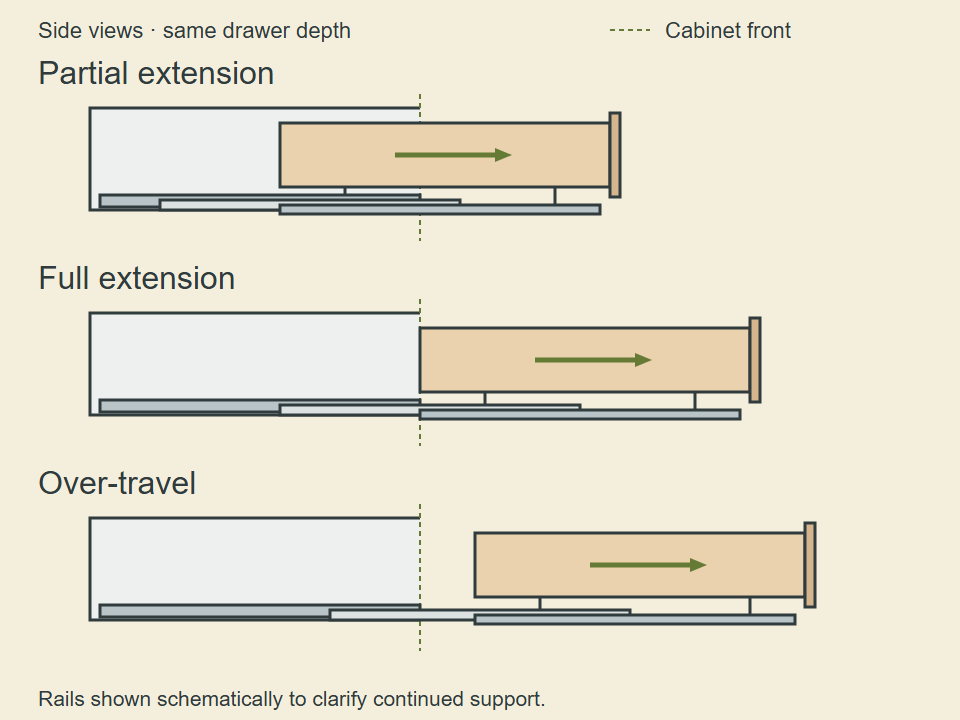
What each term means
- Partial extension
- Slide travel is shorter than its closed length, leaving part of the drawer inside in a typical installation. A listing may describe a particular fraction, but that fraction is not universal for every partial-extension product.
- Full extension
- Travel is approximately the slide’s closed length. With a matching drawer and mounting position, this brings the rear of the box out to the opening. It describes travel, not a guarantee that every part of the storage space clears a countertop or face frame.
- Over-travel
- The slide moves beyond its closed length. That additional travel can improve access past an overhang. Check the exact product’s travel and the furniture layout; “over-travel” is not one standard extra distance.
Is the travel normal, or has something changed?
A smooth, repeatable stop that has always been there may be the intended extension. Do not reach that conclusion solely because the drawer has never opened fully: it may have been installed or replaced recently, or the model may be documented as full-extension.
A drawer that used to come farther out, catches abruptly, binds or stops unevenly needs investigation. Do not remove stops or force it past the limit to create more travel.
I need to check the current travel
Use this when the drawer catches, has lost travel, or may not be opening as its hardware should. The Planner asks only the relevant history and observations.
Troubleshoot limited travelIt works, but I want more access
Use this when you want to explore a full-extension option. The existing slide type and a suitable same-type replacement come before a conversion.
Explore a full-extension upgradeWhat to compare before changing slides
Record the current hardware, its closed length, the drawer depth and usable cabinet depth. Compare the candidate’s actual travel and mounting requirements. Also retain the closing or opening functions you rely on.
A longer slide is not automatically the solution to limited access: it may not fit the cabinet, suit the drawer or provide the required travel. Read upgrading to full-extension drawer slides for the replacement decision.
If the issue is alignment or an obstruction, use the adjustment guide after identifying the cause. For a different drawer problem, start the Planner without a travel assumption.